In The Refuge, the first sign isn’t the lights going out. It’s the little blue dot on every phone that stops moving.
How far is home?
No navigation. No communications. No reassurance that help is coming. If that were tonight, how many days would you walk to reach the people you love?
Who would you walk to?
Add up to six people. Use any name you like; it stays on this device.
To bring them all home
A thought experiment, not a route. How we count.
Would they know where to go?
In The Refuge, the Wilders’ worst days come from being separated — not from being unarmed. A plan for “if we can’t reach each other” is worth more than most gear.
Michael’s checklist asks three questions. Answer them here, then send the answers to the people on your map.
Two places: one near home, and one out of town in case you can’t get back. That’s Ready.gov’s advice too.
One person out of town that everyone checks in with. Ready.gov: they “may be easier to reach in a disaster.”
How long you’ll wait, where you’ll go next, and how you’ll leave word. Ready.gov says to text rather than call, to keep the lines open.
Put the numbers on paper
In a 2015 survey of 1,000 Americans, two in three could still recall the phone number of the house they lived in at 15. Only about a third could dial their own child’s. Write down every number on your map, and keep a copy in a wallet or a bag.
Doing this with your church or small group? Read it together
Then pack for it: your first 72 hours
For a printed version to keep with your papers, Ready.gov has an official family emergency communication plan form .
It happens
After Hurricanes Katrina and Rita in 2005, the National Center for Missing & Exploited Children took 5,192 reports of children separated from their families. Bringing the last child home to her mother took six and a half months.
“The LORD watch between you and me, when we are out of one another’s sight.”
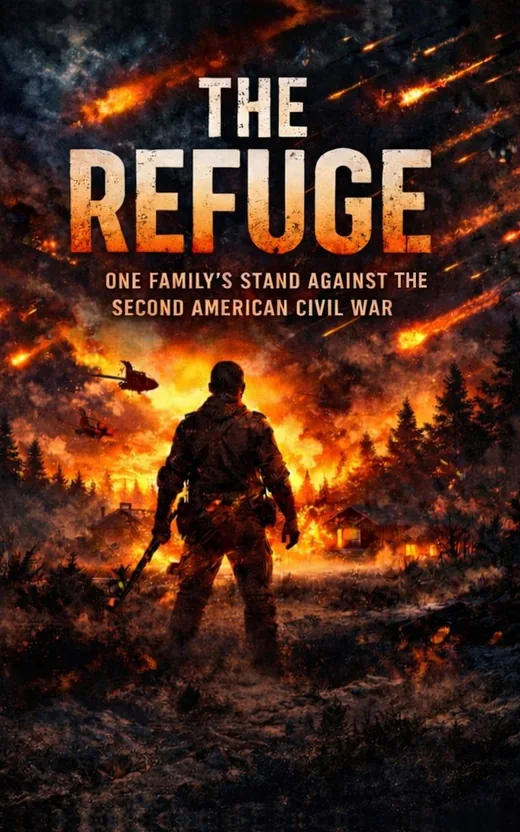
The Refuge · Book One
Every mile home is an act of faith.
Jason sets out across a broken country to bring his family home. Book One follows the Wilder family from the first silent hour to the mountain they try to hold.
How we count
A starting point, not a route.
- Road miles. The straight-line distance between the two places, times 1.2. American roads run about a fifth longer than the straight line (Ballou, Rahardja and Sakai, 2002). Trips to or from Alaska use 1.5, for the long way round through Canada, and are rougher still.
- Days. Road miles divided by your pace, rounded up. Families on the Oregon Trail usually made 12 to 15 miles a day, walking beside their wagons (National Park Service), and an Army march day is eight hours at 4 km an hour, about 20 miles. With a rest day, every seventh day stands still.
- By car. The same road miles at an average of 55 miles an hour.
- What it leaves out. Hills, rivers, weather, short winter days, water, blisters, roadblocks and the rest. Treat the number as the start of a conversation.
- Places. A ZIP code is matched to its own spot, and a town to the middle of its ZIP codes, from a public list of 39,191 ZIP codes that is built into this page.
Private by design
Nothing you type leaves this page, and it never asks your phone where you are. The card you share shows first names and days, never places.
Your list is kept on this device only if you tick “Remember my list.”
Sources
- Michael Bath, What Happens If GPS Goes Dark? (October 2026) and The First 72 Hours (July 31, 2026).
- Ballou, Rahardja and Sakai, “Selected country circuity factors for road travel distance estimation,” Transportation Research Part A 36 (2002): United States 1.20.
- National Park Service, Traveling the emigrant trails; Oregon Encyclopedia, Oregon Trail.
- U.S. Army FM 7-10, Appendix H (“the normal rate of march for an 8-hour march is 4 kmph”) and ATP 3-21.18, Foot Marches (2022).
- Ready.gov, Make a Plan and the family emergency communication plan form.
- Kaspersky Lab survey of 1,000 U.S. adults by Opinion Matters, reported by InformationWeek, July 6, 2015.
- NBC News, Agency: Largest child-recovery effort complete, March 2006.
- Francis Galton, Isochronic Passage Chart for Travellers (1881), the idea behind “In days.”
- Scripture: Genesis 31:49, English Standard Version. Unless otherwise indicated, Scripture quotations are from the ESV® Bible (The Holy Bible, English Standard Version®), © 2001 by Crossway, a publishing ministry of Good News Publishers. ESV Text Edition: 2025. The ESV text may not be quoted in any publication made available to the public by a Creative Commons license. The ESV may not be translated in whole or in part into any other language. Used by permission. All rights reserved.

The Refuge · Book One
Jason had to cross a country at war to bring his family home.
That journey is Book One. Its audiobook and graphic novel are free in the Reader’s Circle.